
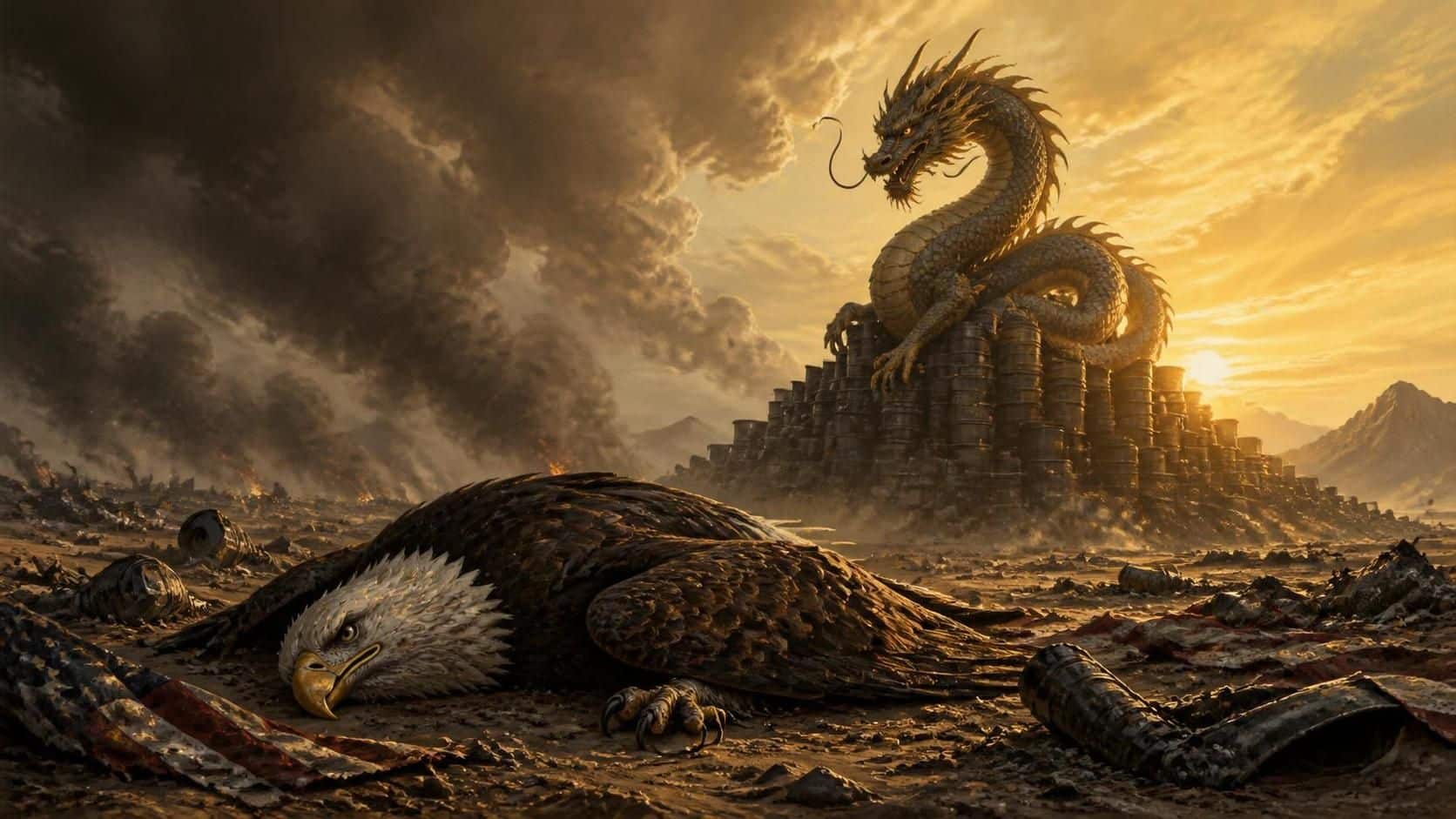
China has not fired a single shot in the Iran-United States war. Yet it may be the main beneficiary. It has observed, it has waited, it has reaped. While the United States was depleting its missile stocks, Beijing made sure Iran remained dependent on its oil. While Washington was bogging down in the Middle East, China was strengthening its position in Asia. Without fighting. Without negotiating. Without even saying so.
How is such a situation possible? The answer lies in a single word: patience. Where Washington and Tehran are burning their forces in a war of attrition, Beijing is cultivating a strategy that is anything but new: the “long game”. Waiting. Watching. Letting others exhaust themselves. And reaping the rewards when they fall.
Let us look at the facts. They are stubborn.
Iranian oil, first. Today, 80% of Iranian exports go to China. That represents 1.38 million barrels per day. A huge figure. And a dependence that suits Beijing. Tehran has almost no other customers. American sanctions have locked down the market. The result: Iran is forced to sell its oil at a discount, and China is there to buy it. A tacit agreement, without a treaty, without an official alliance. Just a calculation.
Meanwhile, the United States is depleting its arsenals. The CSIS figures speak for themselves. Forty-five percent of PrSM missiles have been used. Fifty percent of Patriots. More than half of THAAD. Thirty percent of Tomahawks. And restocking will take between one and four years. This is not a detail. It is a strategic window. While America is fighting in the Middle East, it is weakening its ability to respond elsewhere. In Asia, for example. Where China is waiting.
But Beijing is not just counting missiles. It is also watching how they are used. American operations have been monitored in real time by Chinese analysts. The strikes, the counter-strikes, the failures, the successes. Every missile fired is a lesson. Every American mistake is an opportunity to learn. Without risking a single soldier. The Iran-United States war has become a full-scale training seminar for the Chinese military.
And while Washington is bogging down, Beijing is looking elsewhere. Towards Taiwan, precisely. China is convinced that unification will become easier with time. The reports clearly indicate this. The conflict in the Middle East distracts the United States, consumes its resources, and delays any possible intervention in Asia. For Beijing, this is a gift. Time is on its side.
But this strategy has an Achilles’ heel. The Strait of Hormuz.
Every day, 15 million barrels of oil transit through this chokepoint. That represents 34% of global maritime crude trade. China depends on it massively. It has built up reserves, it is true: 1.232 billion barrels, according to Kpler. Enough to hold out for several weeks, perhaps a few months. But if the strait were to close for a prolonged period, China would be exposed. Its factories still run on oil. Its power plants too. Renewable energy, which covers 20% of its consumption, would not be enough to compensate for a major shock. Beijing controls 70% of global renewable supply chains, but this industrial dominance does not protect it from a crude supply disruption.
So Beijing is quietly calming things down.
China does not want Iran to win. Nor does it want the United States to win. It wants the conflict to last. Long enough for Washington to exhaust itself, but not so long that the Strait of Hormuz catches fire. An unstable equilibrium. A tightrope on which Beijing dances in silence.
American analysts have seen it coming. “The United States and Israel fought Iran, and China won.” That is a sentence from the Brookings Institution, a respected think tank. “China has not fought this war, but it may have won it twice.” That is an article from 19FortyFive, a military publication. And Semafor, an international media outlet, sums up the Chinese doctrine in one sentence: “Beijing believes the global balance of power is slowly tilting in its favour.”
This is not a conspiracy. This is not a plot. This is a documented, analysed, verifiable strategy. And it rests on a very ancient concept: Shi. The propensity of things. The art of waiting for the situation to ripen, for the adversary to exhaust himself, for the fruit to fall by itself. Sun Tzu, two thousand five hundred years ago, already understood this. Chinese strategists have simply adapted it to the modern world.
So where do we go from here?
Will China continue its “long game”? That is the most likely scenario. Beijing will not change course. It will buy Iranian oil at low prices, observe American operations, and strengthen its position in Asia while Washington exhausts itself in the Middle East. Without haste. Without noise.
But an external shock could shake everything up. A prolonged closure of the Strait of Hormuz, for example. Or a collapse of the Iranian regime. In that case, China would be forced to react. Protect its supplies, secure its maritime routes, perhaps even intervene. It is not what it wishes. But it is not impossible.
And if the conflict spreads? If Saudi Arabia, the Emirates, or other regional actors were drawn into the war? China’s position would become more fragile. Patience has its limits. Even the greatest power cannot control everything.
China has not fired a single shot. It has not signed a treaty with Iran. It has not sent troops. But it has observed. It has calculated. It has reaped. It has made sure that Iran remains dependent on its oil, that the United States burns through its arsenals, that Taiwan drifts a little further from American concerns.
It has not won the war. But it has not lost it either. And in this conflict, not losing may already be winning.
By the editorial team
Geostrat Watch – Deciphering the world to better anticipate.