
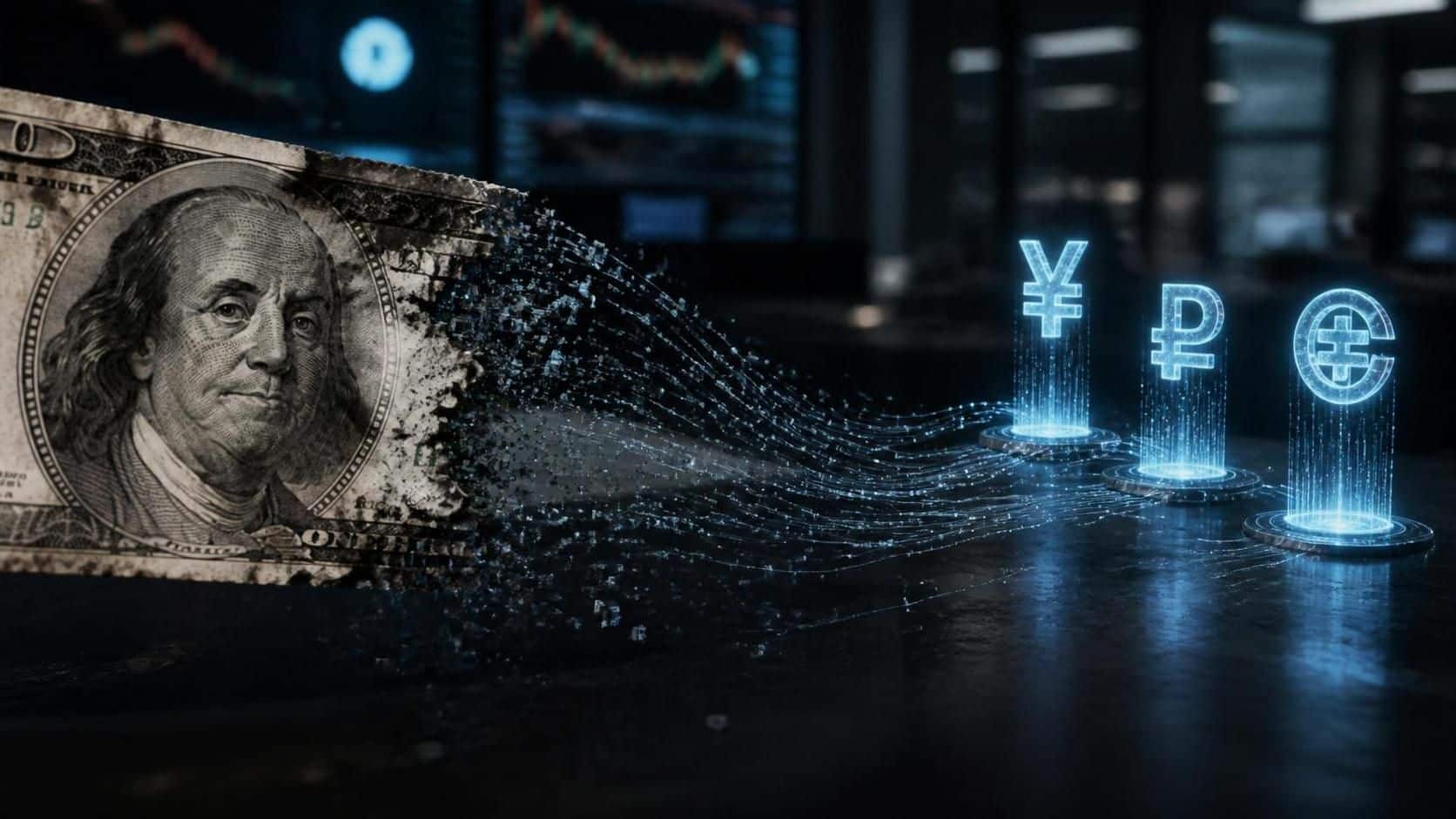
The dollar is no longer what it used to be. In 2001, it accounted for 73% of global foreign exchange reserves. By 2025, that figure had fallen to 54%. A drop of nearly 20 points in two decades. It is not a collapse. It is a slow, steady, almost silent erosion. But it is real.
So what happened? Part of the answer lies in a paradox. The United States has used the dollar as a weapon. Sanctions, asset freezes, exclusion from the SWIFT system. Each time, the message was clear: if you do not follow our rules, we will cut off your access to the dollar.
The problem is that this weapon is now backfiring. Not through conspiracy, not through revenge. Through pure mechanics. When you threaten to cut off someone’s supplies, that person starts looking for other ways to feed themselves. And that is exactly what China, Russia, Iran, and many others have begun to do.
The numbers tell the story. And they are eloquent.
The dollar’s share of global reserves fell from 73% in 2001 to 54% in 2025. A drop of 19 points. Not a crash. A slide. But a slide that has lasted twenty years and, in recent years, has accelerated.
Why? Because sanctions have acted as an accelerator. In 2022, the freezing of Russian reserves stunned many countries. The idea that Washington could seize 300 billion dollars from a sovereign state overnight made more than one central bank think twice. Not just in Moscow or Beijing. In New Delhi, Riyadh, Brasilia. Everywhere, the question was asked: what if one day, it was our turn?
So alternatives began to emerge. Not overnight. But methodically.
China developed CIPS, its own bank messaging system, a competitor to SWIFT. In 2024, CIPS processed 175 trillion yuan in transactions, up 43% year-on-year. Five thousand banks are connected, across 190 countries. It is no longer a prototype. It is an infrastructure.
Russia pushed its SPFS, its domestic payment network. Five hundred and fifty organisations, twenty countries. Modest, but functional.
But the movement has spread far beyond these two players. mBridge, a platform launched by the Bank for International Settlements with China, Thailand, and the United Arab Emirates. In 2024, it processed the equivalent of 387 billion yuan. The key detail? Ninety-five percent of these transactions were in digital yuan. Not dollars.
Within the BRICS, 60 to 67% of intra-BRICS trade is now conducted in local currencies. And for the Sino-Russian relationship alone, the figure reaches 92%. The rouble and the yuan have almost entirely replaced the greenback in trade between Moscow and Beijing.
Does all this mean the end of the dollar? No. The dollar remains the leading reserve currency, the leading transaction currency, the leading invoicing currency. It has not been replaced. But it is no longer alone.
This is where the paradox becomes interesting. Each new sanction, each new asset freeze, each new threat of exclusion pushes target countries a little further towards seeking alternatives. And these alternatives, once created, do not disappear when the sanction is lifted. They remain. They improve. They compete.
A former IMF director, Paulo Batista, put it bluntly: “The United States is the dollar’s main enemy.” This is not a slogan from an adversary of America. It is a technical observation. The weapon is effective in the short term. But in the long term, it erodes trust. And trust is the foundation of the dollar.
So where do we go from here?
Three scenarios emerge.
The first: the race accelerates. Sanctions continue. The BRICS expand their cooperation. A common settlement currency emerges — not to kill the dollar, but to coexist. The global payment system fragments. Not into two blocs, but into regional ecosystems. America loses its monopoly, but the dollar is not dead. It is simply dethroned from its unique pedestal.
The second: an unstable equilibrium. De-dollarisation slows. Alternatives exist, but remain fragmented, each dominating its own region. The dollar retains its status, but no longer reigns alone. It is first among equals, not the sole master. The world is learning to live without it, but has not yet driven it out.
The third: a temporary reprieve. A major geopolitical agreement — for example between Trump and Russia — could slow the movement. Not stop it. But give it a breather. Sanctions ease, pressure subsides, and the dollar regains some ground. For how long? That is the question. Because the alternatives are already there. They do not disappear. They are just waiting.
None of these trajectories is certain. They are all plausible. And perhaps that is the most important thing. De-dollarisation is not a prophecy. It is not a political project driven by one camp against another. It is a mechanical consequence. A survival reflex of states that feel threatened.
The dollar has been a weapon. It remains one. But like any weapon, its repeated use creates defences, countermeasures, alternatives. The United States is not losing the dollar. It is spending it.
Geostrat Watch – Deciphering the world to better anticipate.