
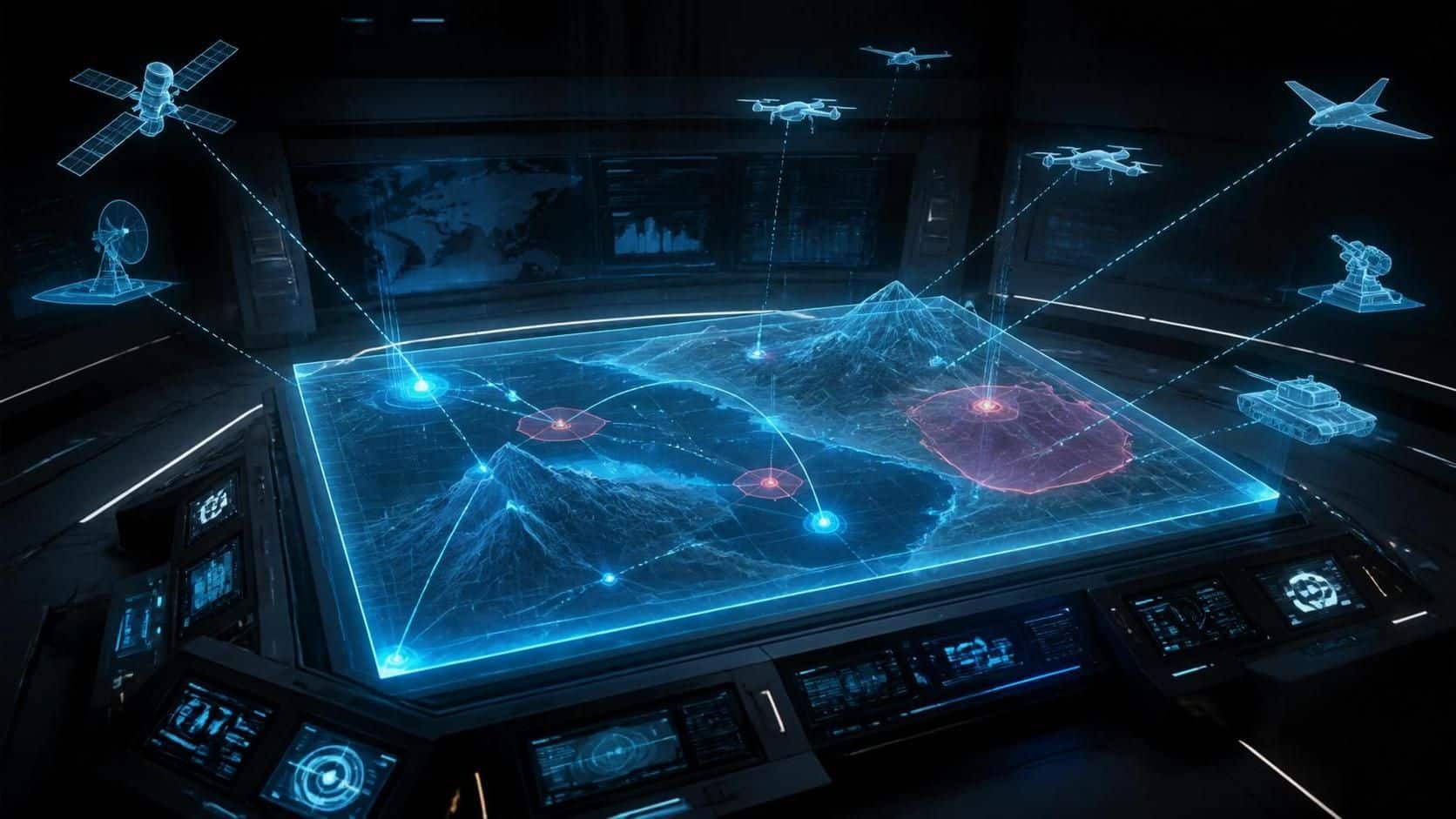
Artificial intelligence is no longer a promise. It is a force multiplier on the modern battlefield. From satellites to drones, from command centres to encrypted messaging, AI is no longer just assisting. It is guiding, anticipating, deciding.
Let us look at what is happening on the ground.
On 16 July 2026, an American Patriot air defence system was destroyed at Erbil airport in Iraq. An Iranian Shahed-136 drone, coordinated by swarm flight algorithms, struck with surgical precision. Satellite imagery confirmed it within hours.
At the same time, American strikes were targeting the port infrastructure of Bandar Abbas and Qeshm Island. Image analysis from Maxar and Pléiades satellites made it possible to assess the damage and adjust subsequent strikes in near real time. AI reduces the time between impact and target reassessment. What used to take days now takes hours.
In the Black Sea, Ukrainian naval drones were sunk by Russian Lancet munitions. These systems use target recognition algorithms to engage mobile targets with increased accuracy.
Behind every strike, every interception, every analysis, there are years of research and billions in investment. The AI war is first and foremost an industrial war.
The United States is betting on an integrated approach. The JADC2 programme aims to connect all sensors and all shooters into a single AI-driven network. Russia has developed electronic warfare systems like the Krasukha-4, capable of jamming enemy communications, and guided munitions like the Lancet and Geran, optimised by algorithms. Iran has turned AI into an asymmetric power lever. The Shahed-136 drones, used in swarms, are coordinated by group flight algorithms. The Kheibar Shekan missiles incorporate terminal guidance systems that improve accuracy in the final phase.
China, for its part, is developing drone and reconnaissance systems integrating AI, particularly for maritime surveillance. Europe, via the European Defence Fund, is funding military AI projects, but remains in catch-up mode.
But AI is not only a weapon of destruction. It is also a weapon of persuasion and control.
Videos and images generated by AI are already circulating on Telegram and social networks. They are used to create false evidence, to shape public opinion, to discredit opposing sources. Deepfakes have become a tool of large-scale disinformation.
The platforms, for their part, use AI to moderate content. Google, Meta, X apply filtering algorithms that are sometimes perceived as political censorship by alternative channels. AI decides what is visible and what is not.
In this landscape, the AI arms race is only just beginning. The United States and China are vying for technological superiority. Russia and Iran are betting on asymmetry. Europe is trying not to fall behind.
The scenarios are open. A major technological breakthrough could give one actor a decisive advantage. A generalised hybrid war could turn deepfakes and disinformation into full-fledged weapons of war. An international agreement could attempt to regulate the use of AI in conflict.
One thing is certain. AI is no longer a simple tool. It has become a strategic actor that is redefining the balance of power, military doctrines and geopolitical balances. Understanding its role is not an option. It is a necessity.
By the editorial team
Geostrat Watch – Deciphering the world to better anticipate.