
The Houthis are closing the Red Sea to Saudi Arabia. Eight tankers struck since July 22. Twenty-nine forced to turn back. Brent crude has passed 100 dollars a barrel.
And Washington? Nothing.
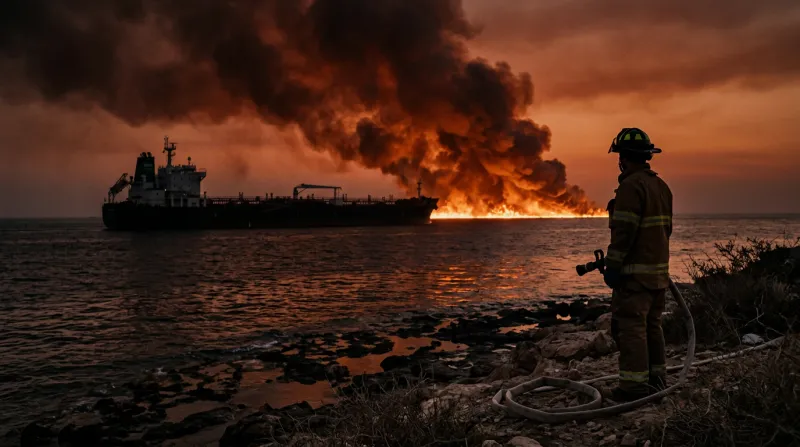
The firefighter is watching the blaze. He has no water left.
The strike on Yanbu
On August 5, two Saudi tankers were struck off Yanbu, in the northern Red Sea. This was not an isolated attack. It was the eighth since July 22.
The Houthis are striking in broad daylight. They are no longer hiding. Their zone of operations has expanded from Bab al-Mandab in the south to Yanbu in the north. Saudi Arabia, the world’s leading oil exporter, is caught in a vise between two maritime jaws. There is no way out.
A tanker captain leaves Ras Tanura with two million barrels. He knows he must pass through Bab al-Mandab. He knows the Houthis are striking tankers. He knows the U.S. Navy will not protect him. He sails anyway. He is paid to do it.
The toll
Eight Saudi tankers struck. Twenty-nine turned back. The blockade, once limited to the Bab al-Mandab strait, is now extending northward. The Houthis are striking at Yanbu — a target once thought out of range.
Lloyd’s List estimates that 12 percent of global trade is disrupted. Saudi Arabia is forming an international coalition to try to secure its maritime routes. But its traditional allies are elsewhere. The United States? Exhausted by the war in Iran. Europe? Fractured and dependent on gas.
Riyadh is alone. And its tankers are burning.
Oil catches fire
Brent has crossed 100 dollars a barrel. Every strike on a Saudi tanker pushes the price higher. Every tanker turning back tightens supply.
The global economy, already under strain, is absorbing the shock. Prices at the pump are climbing. Transport costs are exploding. And no one can stop the escalation.
Washington silent
The U.S. Navy is deployed in the Red Sea. It is there. It sees. It does not intervene.
Why? Because the United States is emerging from a disastrous war in Iran. Its arsenals are empty — over 850 Tomahawks fired, 67 percent of Patriots consumed. Its credibility is in tatters — Trump at 35 percent, GOP fractured, debt at 35 trillion.
It cannot open a third front. It cannot protect its allies. It can do nothing.
An American diplomat reads the dispatches. Eight tankers struck. Twenty-nine turned back. Brent above 100 dollars. He awaits instructions from Washington. None come. The firefighter has no water left.
Iran behind the Houthis
The Houthis are not an isolated group. They are an Iranian proxy. Their maritime blockade is a direct extension of the war between Iran and the United States.
If Washington cannot control Tehran at Hormuz, it cannot control the Houthis in the Red Sea. Iran has understood that the United States is on its knees. It is pushing everywhere at once. Hormuz in the north. The Red Sea in the south. And in between, a Saudi Arabia being strangled.
The fall without a net
American allies are under attack. Washington is not responding. Oil is catching fire. Global trade is under threat. No one can stop the escalation.
The allies are burning. The firefighter has no water left.
This is what we have been calling, since August 6, the fall without a net. Here and now, in the Red Sea.
By the editorial team
Geostrat Watch – Deciphering the world to better anticipate.anticiper.
Sources :
- https://www.nytimes.com/houthis-saudi-tanker
- https://www.bloomberg.com/houthis-red-sea
- https://www.reuters.com/houthis-saudi-tanker
- https://www.aljazeera.com/houthis-red-sea
- https://www.arabnews.com/saudi-red-sea
- https://www.hngn.com/houthis-eighth-tanker
- https://www.twz.com/houthis-saudi-tanker
- https://www.reuters.com/houthi-blockade
- https://www.newarab.com/houthi-blockade
- https://www.lloydslist.com/red-sea
- https://www.reuters.com/brent-100
- https://www.nytimes.com/saudi-coalition
- https://www.theguardian.com/saudi-offensive
- https://www.instituteforenergyresearch.org/saudi-coalition
- https://www.reuters.com/us-red-sea
- https://www.state.gov/red-sea