
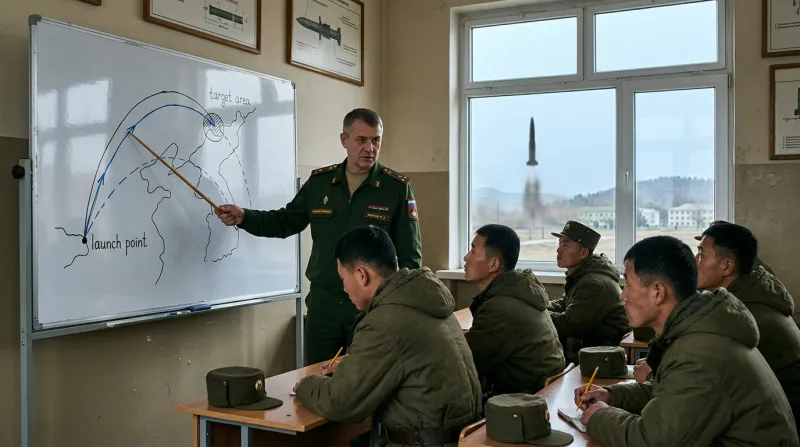
Ninety North Korean soldiers are in Voronezh. They are not there to save Russia — Russia does not need saving. They are there to learn.
Russia’s 112th Missile Brigade is training them on the KN-23, ballistic missiles with a range of 450 to 690 kilometers. Six launchers are already on site. Forty missiles delivered out of 120 planned. These men are not an operational force. They are the future officers of the North Korean army.
Voronezh is not a battlefield. It is a classroom.
The deployment
Reuters confirmed the information on August 6. Ukrainian military intelligence, the GUR, provided the details: 90 North Korean soldiers deployed with Russia’s 112th Missile Brigade, equipped with six KN-23 launchers. Moscow plans to deliver 120 missiles in total.
The KN-23 is a formidable weapon. Range: 450 to 690 kilometers. Warhead: 500 kilograms. CSIS compares it directly to the Russian Iskander-M — the missile that has struck Ukrainian defenses for four years.
These 90 soldiers are learning to program it, adjust its trajectory, circumvent anti-missile defenses. They are taking notes. In six months, they will return to Pyongyang. Each will train twenty more soldiers. In two years, North Korea will have a credible strike force — trained by the Russian army, tested under real conditions against Western systems.
Why 90, not 30,000?
Russia deployed 14,000 North Korean soldiers in 2024, in the Kursk region. It is preparing 30,000 more, according to Yonhap and Zelensky. So why only 90 in Voronezh?
The answer is simple. This is not an operational force. It is a training unit.
If Moscow were on its knees, it would deploy 30,000 soldiers, not 90. It would train Russian conscripts, not North Korean officers. The fact that it is taking the time to transfer its expertise to another country’s army is a signal of strength, not weakness. Russia has enough resources to wage its war AND train its allies.
The North Korean soldier in Voronezh is not a mercenary. He is an investment.
The KN-23, a game-changer
Deployed from the Korean peninsula, the KN-23 changes the strategic calculus in Northeast Asia.
Range of 690 kilometers: all of South Korean territory is within reach. American bases at Daegu, Pyeongtaek, Osan as well. Japan is covered as far as Hiroshima. Part of Guam — American territory — falls within the strike radius.
The 500-kilogram warhead is sufficient to destroy a bunker, an airstrip, a command center. And these missiles will be operated by officers trained by the army that has been fighting NATO for four years. Pyongyang did not have this expertise six months ago. Today, it is acquiring it.
The Moscow-Pyongyang axis without Beijing
The mutual defense treaty signed in 2024 between Russia and North Korea has already produced concrete results. Millions of artillery shells delivered in 2025. Soldiers deployed to Kursk. And now, a missile unit training in Voronezh.
What is striking is China’s absence.
According to RAND and East Asia Forum, Beijing is kept out of the military rapprochement between Moscow and Pyongyang. China watches, but does not participate. The axis is being built without it — and potentially against its long-term interests. The reshaping of the world order no longer necessarily passes through Beijing. It passes through bilateral alliances that escape all control.
Tokyo and Seoul are worried
Japan has published its 2026 Defense White Paper. It explicitly designates North Korea, China, and Russia as threats. NHK and Kyodo report growing concern within the Japanese government.
South Korea is strengthening its surveillance. Yonhap and the Korea Times document emergency meetings at the Defense Ministry in Seoul. The message is clear: Pyongyang is no longer isolated. It is connected to one of the world’s most battle-hardened armies.
A Japanese strategist reads the Voronej report. He sees 90 soldiers. He knows this is not an immediate threat. But he also knows these 90 soldiers will train 900, then 9,000. He writes a memo to the Prime Minister: “North Korea is learning modern warfare. We must prepare.”
The fall without a net in Asia
The West is absent from this equation. The United States is bogged down in Iran. Europe is fractured. No one counterbalances the Moscow-Pyongyang axis. Japan and South Korea are alone.
The Asian order is tipping. And no one is holding the net.
This is what we have been calling, since August 6, the fall without a net. In Asia too.
By the editorial team
Geostrat Watch – Deciphering the world to better anticipate.
Sources :
- https://www.reuters.com/north-korea-missile-unit-2026
- https://www.gur.gov.ua/north-korea-russia-2026
- https://www.nknews.org/north-korea-missile-2026
- https://www.rte.ie/north-korea-russia-2026
- https://www.timeslive.co.za/north-korea-russia-2026
- https://www.csis.org/kn-23
- https://www.yonhapnews.co.kr/north-korea-troops-2026
- https://www.reuters.com/russia-north-korea-treaty
- https://www.38north.org/north-korea-balances-2026
- https://www.csis.org/russia-north-korea-cooperation
- https://www.mod.go.jp/defense-white-paper-2026
- https://www.kyodonews.net/japan-reaction-north-korea
- https://www.yonhapnews.co.kr/south-korea-monitoring-2026
- https://www.koreatimes.co.kr/south-korea-reaction-2026
- https://www.rand.org/russia-north-korea-2026
- https://www.eastasiaforum.org/china-north-korea-2026