
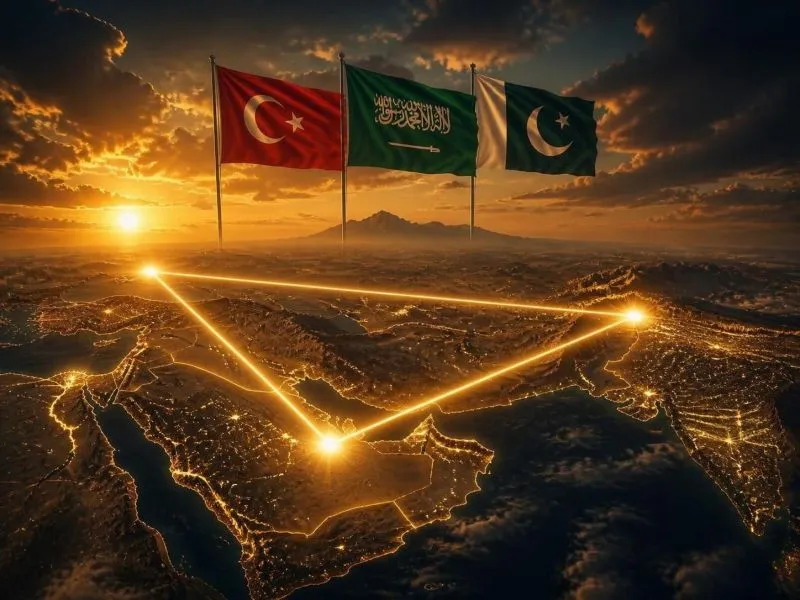
Jeddah, August 7, 2026. Three men sign a document. Recep Tayyip Erdogan, Mohammed bin Salman, Shehbaz Sharif. The Middle East has just changed shape.
The trilateral defense agreement between Turkey, Saudi Arabia, and Pakistan is not a simple diplomatic communiqué. It is a strategic realignment that creates a new security hub — Saudi financial power, Turkish defense industry, Pakistani military capability.
The day before, Houthis were striking Saudi bases. Fifty-eight dead. Washington did not react. Today, Riyadh is signing with Ankara and Islamabad.
The American void has just produced its first offspring.
What the agreement provides
The text provides for defense coordination, military training, intelligence sharing, and industrial cooperation in armaments and drones. The precise details have not been made public. But the architecture is clear.
Saudi Arabia provides the financing. Turkey provides its defense industry — the Bayraktar drones proven in Ukraine, Syria, Libya; warships; electronic systems. Pakistan provides its nuclear power and the world’s second-largest Muslim army.
Three Sunni powers facing Shia Iran. A strategic counterweight that did not exist forty-eight hours ago.
A logical progression
The agreement does not come out of nowhere. In 2025, Saudi Arabia and Pakistan had already signed a bilateral agreement stipulating that an attack on one would be considered an attack on the other. Turkey is now joining it.
For months, the three capitals have been talking. The war in Iran accelerated the timeline. The American silence in the face of the Houthi strikes of August 6 precipitated everything.
An advisor to the Saudi crown prince watches the signing. He remembers the day before. The missiles on Najran. The four-year-old child wounded. Washington’s silence. Today, Saudi Arabia is no longer calling America. It is signing with Ankara and Islamabad.
The American void as catalyst
The agreement is the direct consequence of American silence. On August 6, the Houthis struck. Fifty-eight dead. Neither CENTCOM nor the State Department reacted. On August 7, Riyadh signed a defense agreement with two Muslim powers.
The message is clear: Saudi Arabia no longer believes in American protection. Washington, exhausted by five months of war in Iran, no longer has the means to be the Gulf’s policeman. Allies are organizing without it.
Turkey, a NATO member, signs a defense agreement with non-NATO countries. Ankara is demonstrating that its strategic autonomy is not a slogan. Erdogan is no longer in the Western camp by default. He is where his interests dictate.
The silences
Iran made no comment. The State Department neither. China neither.
Three silences that speak volumes. Tehran sees a Sunni axis emerging on its borders — Pakistan to the east, Saudi Arabia to the south, Turkey to the north. Washington sees a NATO ally emancipating itself and building parallel alliances. Beijing, trade partner to all three countries, watches without taking a position.
Silences are sometimes louder than statements.
A seawall or a conflict magnet?
The Ankara-Riyadh-Islamabad alliance is designed to contain Iran. But deterrence has two faces. It can stabilize — or it can provoke.
If Tehran perceives this agreement as an existential threat, it could accelerate its nuclear program, strengthen its support for the Houthis, activate its militias in Iraq and Lebanon. If, on the contrary, it perceives it as a credible signal of firmness, it could choose restraint.
The question is not whether this alliance is legitimate. It is. The question is whether it can deter without triggering.
Alliances are being redrawn. Silences are accumulating. The Middle East is changing shape. And no one yet knows what shape it will take.
By the editorial team
Geostrat Watch – Deciphering the world to better anticipate.
Sources :
- https://reuters.com/turkey-saudi-pakistan-defence
- https://reuters.com/turkey-saudi-pakistan-agreement
- https://al-monitor.com/saudi-turkey-pakistan-defence
- https://euronews.com/saudi-turkey-pakistan-defence
- https://france24.com/saudi-pakistan-turkey-defence
- https://usnews.com/saudi-turkey-pakistan-defence