
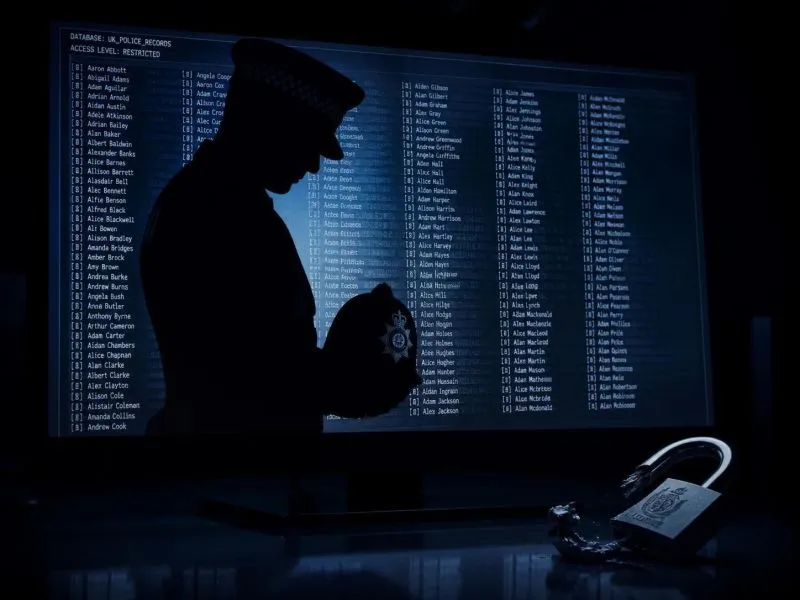
On July 26, 2026, a digital shadow fell over British law enforcement. One hundred thirty thousand names. One hundred thirty thousand email addresses. One hundred thirty thousand phone numbers. Online. On the dark web. Accessible to anyone who knows where to look.
The cause is almost laughable. A misconfiguration of Microsoft Power Platform. Not a sophisticated hack. Not a hostile state operation. A box left unchecked in a settings panel.
The group ExfilSquad published the data. The United Kingdom, which prided itself on being a global leader in cybersecurity, is discovering that its own police officers are not protected.
The leak: what we know
The Police National Legal Database, the legal reference system used by the 43 police forces of England and Wales, was compromised. The exposed data covers full names, professional email addresses, phone numbers, and affiliated organizations of 130,000 to 135,000 officers.
The scope is staggering. The 43 territorial police forces. The Home Office. The Ministry of Defence. The National Crime Agency. The Crown Prosecution Service. The entire British law enforcement system is affected.
The PNLD confirmed the leak on August 3. The investigation is ongoing. But the data is already out there.
ExfilSquad: newcomers who hit hard
ExfilSquad is not a household name. But in the world of cyber intelligence, it is starting to cause fear.
The group emerged recently. It has already claimed 16 documented incidents. Including the theft of 607,000 records from the Department for Education. The progression is rapid, methodical, disturbing. Each target is more sensitive than the last. Each leak is more massive.
Microsoft. The Department for Education. Now the police. Tomorrow, what? Intelligence services? Military bases? The group is escalating. And no one seems capable of stopping it.
Officers turned targets
The implications are immediate, concrete, personal.
A drug trafficking gang can now identify the officer leading the investigation into its activities. A terrorist network can map out intelligence units. Hostile states can cross-reference this data with other leaks for destabilization operations.
A Manchester detective wakes up one morning. He checks the security alerts. He discovers that his name, his position, his professional email address are online. Accessible to any criminal. He has a wife. Two children. He wonders whether he should tell them.
Trust in the police institution, already weakened by years of budget cuts and scandals, takes another hit. The fundamental contract between the state and its servants — you protect us, we protect you — is broken.
A system cracking
The United Kingdom has massively invested in surveillance and data collection. But it has not invested in protecting that data.
The PNLD leak is not a technical exploit. It is a configuration error on a Microsoft platform. The kind of error a basic security audit should have caught. The kind of error that reveals a deeper problem.
Data is fragmented across dozens of subcontractors and legacy systems. Security depends on the weakest link. And the link has snapped. The DfE, 607,000 records. The police, 130,000 officers. Two leaks in the same series, by the same group. This is not a coincidence. This is a system cracking.
The silence: London no longer answers
The PNLD confirmed the leak. Those affected have been informed. But the British government has made no major public statement.
No press conference from the Home Secretary. No communication from Downing Street. No address to the nation. Nothing.
This silence speaks volumes. It suggests either deep embarrassment, or an inability to measure the scale of the damage. Or both. The United Kingdom, which claimed to set the standard in cybersecurity, has no words even for its own police officers.
The state that no longer protects
The contract is simple. The state asks its officers to protect it. In return, it promises to protect them.
That contract has just been broken.
One hundred thirty thousand British police officers are exposed. Their names are out in the open. Their families are potentially threatened. And their government remains silent.
The breach is open. What will come flooding through it remains to be seen.
By the editorial team
Geostrat Watch – Deciphering the world to better anticipate.
Sources :