
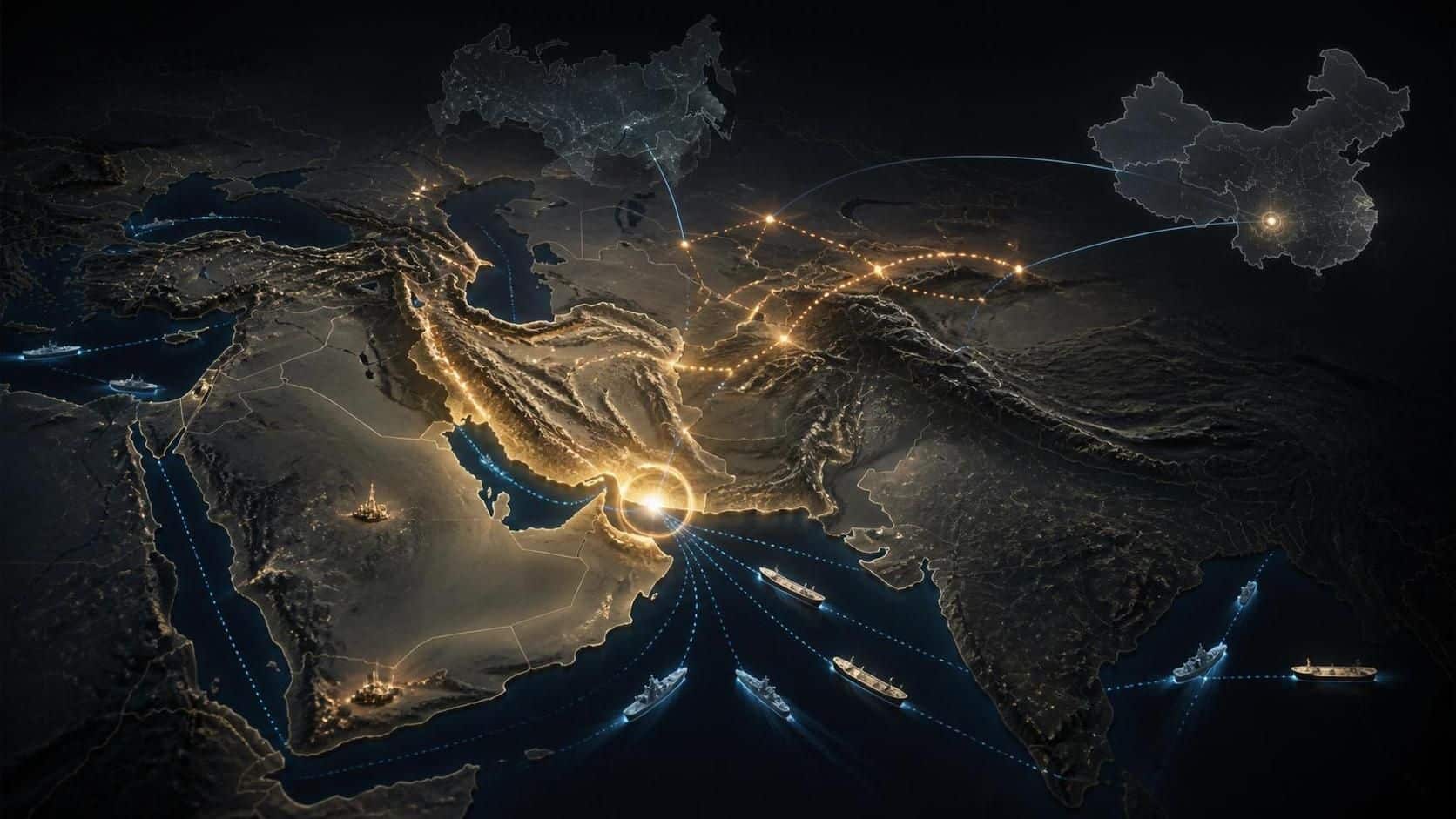
The resumption of the conflict between the United States and Iran in the summer of 2026 is far more than yet another crisis in the Middle East. It is the symptom of a global shift. To understand this war, we must stop viewing it as a bilateral confrontation. We must read it as a desperate manoeuvre by a hegemonic power that refuses to relinquish its place.
The thesis is simple. Iran is not the target. Iran is a pretext. Washington’s real target is the multipolar world that is emerging, carried by China, Russia and their allies.
Why Iran? Because its geographical position is one of the most strategic on the planet. Twenty percent of the world’s oil transits through the Strait of Hormuz. Twenty million barrels per day. The country is the crossroads of China’s New Silk Roads and the North-South transport corridor linking Russia to the Indian Ocean. Controlling Iran, or failing that destabilising it, means locking down the energy and trade routes that allow China and Russia to bypass American maritime dominance.
Mohsen Rezaï, military advisor to the Iranian Supreme Leader, put it bluntly: the Strait of Hormuz is “more important than dozens of atomic bombs”. A sentence that sums up the stakes on its own.
The war against Iran serves three major strategic objectives.
The first is to contain China. Beijing depends on Iranian oil imports for 90% of its economy. By threatening the Strait of Hormuz, Washington is seeking to suffocate its main rival.
The second is to weaken Russia. Moscow has made Iran a strategic ally, a military partner and a pivot of its North-South corridor. Striking Iran means depriving Russia of a key ally in the Middle East.
The third, more subterranean but equally vital, is to save the dollar. Iran sells its oil in yuan and roubles. It is a member of BRICS+, which now represent half of the world’s population and 35% of global GDP. The BRICS+ common currency project could, according to analysts, “cause a significant fall in the US dollar”. By striking Iran, Washington is sending a message to all those who would be tempted to leave the petrodollar system.
But this strategy is a risky gamble. And the first results suggest it could produce the exact opposite of the desired effect.
By attacking Iran, Washington is strengthening the cohesion of the China-Russia-Iran axis. The three capitals, which sometimes had diverging interests, are now welded together by a common threat. By imposing new sanctions, the United States is accelerating de-dollarisation. Each restriction on dollar transactions pushes Beijing, Moscow and their partners a little further towards developing alternative payment systems.
Finally, by engaging on a new military front, Washington is offering China an invaluable geopolitical gift: a strategic respite. While America is focused on the Middle East, Beijing is strengthening its positions in the Asia-Pacific, Africa and Latin America.
The human losses, meanwhile, are mounting. Fifty-two dead on the American side, more than 520 wounded. Iranian losses are estimated at between 3,500 and 7,800 dead. The International Energy Agency speaks of “the most severe oil supply shock in history”. The price of a barrel has already exceeded 120 dollars before falling back to 88 dollars on 20 July.
So where do we go from here? The conflict could exhaust itself in a bloody status quo. A diplomatic agreement could emerge, under Chinese, Turkish or UN mediation. The escalation could spread to Lebanon, Syria, Yemen and the Gulf monarchies. The worst is never certain, but it is never impossible.
One thing is certain. The Iran-United States conflict is an accelerator of History. It does not mark the end of the unipolar world. It is its confirmation. The transition to a multipolar world is underway, and every missile fired is one more milestone.
By the editorial team
Geostrat Watch – Deciphering the world to better anticipate.