
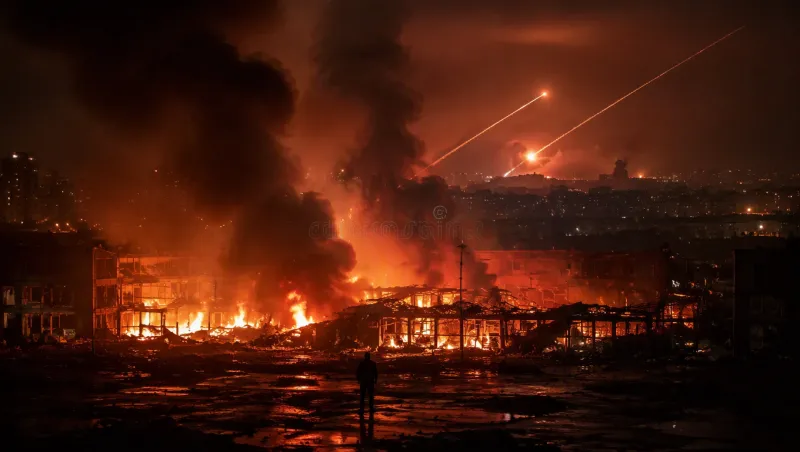
On the night of August 4, Kyiv burned. Not the outskirts. The country’s logistical heart.
Twenty-eight missiles. One hundred and fifteen drones. Sirens wailing above the capital. And on the ground, warehouses collapsing in flames — Rozetka, Nova Poshta, Epicentr. Names every Ukrainian knows.
Why these targets? Why strike the Ukrainian Amazon, the national postal network, a hardware store? Because the war has changed in nature. Russia is no longer targeting only the Ukrainian army. It is targeting what keeps it going.
The strike
The Ukrainian air force claims to have intercepted 21 missiles and 97 drones. An interception rate that, on paper, borders on excellent.
But the damage on the ground tells a different story. Warehouses on fire. Infrastructure gutted. Hundreds of thousands of square meters reduced to ash. Several projectiles breached the defenses. And those that got through did not need to be numerous to inflict massive damage.
The official statement speaks of interceptions. The flames speak of impacts.
The targets
Rozetka. One hundred thousand square meters. One hundred thousand orders a day. Ukraine’s Amazon. Destroyed.
Iryna Chechotkina, co-founder of the company, found the right words: “I saw everything I had worked for my entire life reduced to ashes.”
Nova Poshta. The logistical network that irrigates the country, from daily mail to front-line supply. Damaged in the Obolon district.
MLP-Chaika. A logistics center on the outskirts of Kyiv. Possibly a drone assembly site. Destroyed.
Novus. Epicentr. Liqui Moly Ukraine. Supermarkets, a hardware store, an engine oil supplier. The everyday economy, struck.
These are not military targets in the classical sense. They are economic targets. Russia is not just seeking to destroy tanks. It is seeking to sever the flows that fuel Ukraine’s war machine. Engine oil, spare parts, postal logistics — everything is war infrastructure when the entire country is at war.
Air defense under strain
Patriot systems are running low. CNN and the Washington Post confirm it. CSIS points to a link with the Iran-U.S. conflict: American resources are being drained by the Middle East. Ammunition stocks, already limited, are being stretched across two theaters simultaneously.
Ukraine’s energy minister has stated that 80 percent of the country’s electrical capacity has been destroyed or damaged. Power plants, transformers, high-voltage lines — all struck. And now, the warehouses.
Ukraine is fighting with dwindling stocks. Western aid is being called upon elsewhere. Every missile intercepted is a missile that will not be replaced.
An economic war
A few weeks ago, Ukraine struck Wildberries, the Russian logistics warehouse. Moscow is responding by striking Rozetka. A mirror escalation, infrastructure for infrastructure.
Both sides have understood: an army does not hold without logistics. Tanks without engine oil stop. Soldiers without mail lose morale. Drones without spare parts do not take off. Economic warfare is less spectacular than a tank battle. It may be more devastating in the long run.
The night of August 4 revealed a truth Ukraine did not want to see. The war is no longer only on the front. It is in the warehouses, the supply chains, the cans of engine oil.
How long can a war economy hold when its logistics hubs burn one after another?
The fire devours the warehouses. But it also devours Ukraine’s ability to fight.
By the editorial team
Geostrat Watch – Deciphering the world to better anticipate.
Sources :
- https://www.reuters.com/world/europe/ukraine-russia-kyiv-drone-attack-2026-08-05/
- https://apnews.com/article/russia-ukraine-kyiv-strike-august-2026
- https://kyivindependent.com/russia-kyiv-august-5-2026
- https://www.pravda.com.ua/news/2026/08/5/
- https://www.cnn.com/2026/08/05/europe/ukraine-russia-kyiv-attack
- https://www.csis.org/analysis/patriot-ammunition-iran-ukraine