
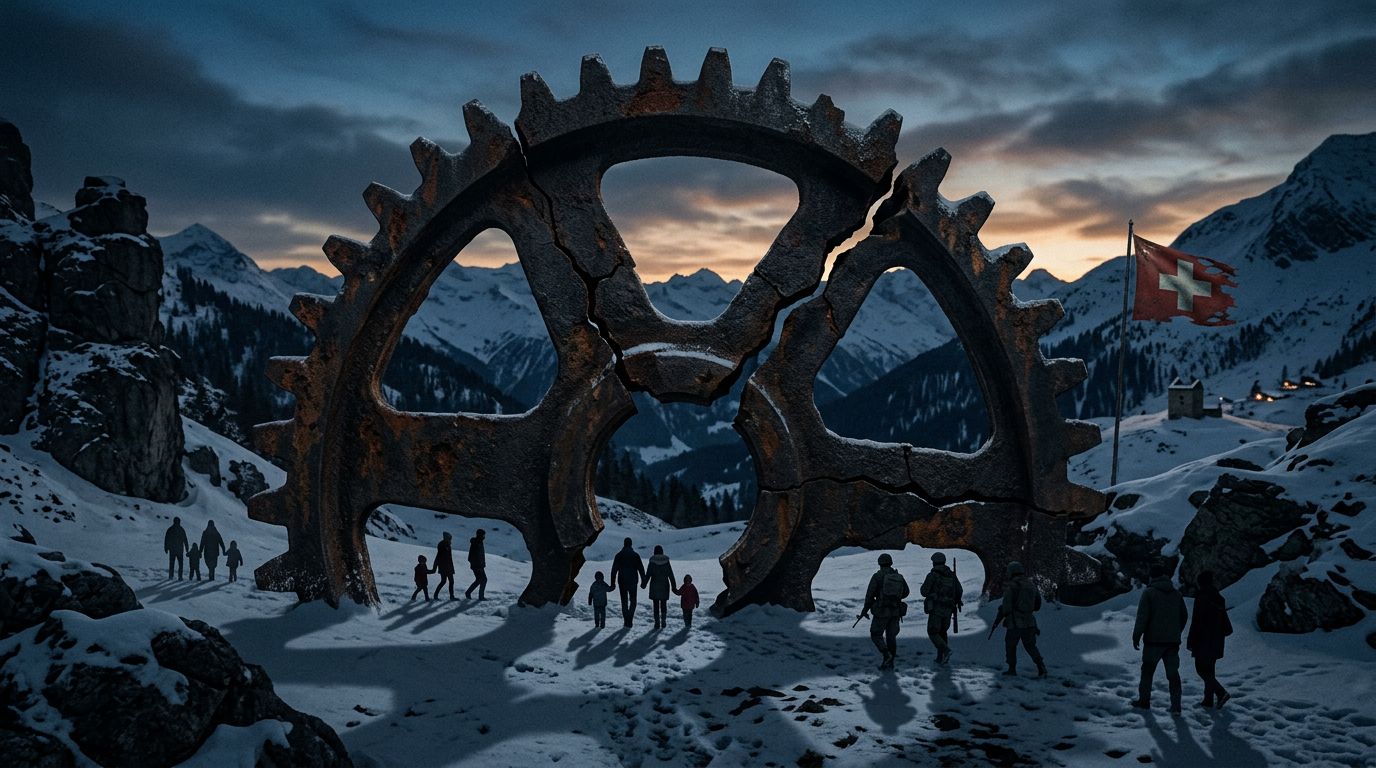
There is an old piece of furniture in the attic of the Confederation. A family heirloom, passed down from generation to generation. Some find it cumbersome, outdated, useless. Others consider it the soul of the house. This piece of furniture is Swiss neutrality. And for the past few years, it has been quietly emptied of its contents.
The problem is that this piece of furniture is not a simple decorative object. It is an international treaty. It cannot be thrown away. It cannot be burned. It is being emptied. And when it is empty, it will still be there — but it will no longer protect anything.
The Legal Foundation
Swiss neutrality is not an opinion. It is a legal obligation.
The Treaty of Paris of 1815, signed at the Congress of Vienna, recognises Switzerland’s perpetual neutrality. It has never been repealed. Russia, France, the United Kingdom, Austria — all the successors of the signatory powers are legally bound by this commitment.
The Federal Constitution enshrines neutrality in domestic law. The Hague Conventions of 1907 define the rights and duties of a neutral state. The distinction is clear: in time of war, Hague law prohibits any participation in the conflict. In time of peace, customary law does not prohibit economic sanctions.
It was this loophole that allowed Switzerland’s alignment with European Union sanctions against Russia in 2022. Legally, it was not a violation of neutrality. Politically, it was a signal. The old piece of furniture was beginning to be emptied.
On 27 September 2026, the Swiss people will vote on the “Safeguard Swiss Neutrality” initiative. They will decide.
Customary Desuetude
This is where the law becomes subtle — and dangerous.
Customary international law rests on two pillars: the general practice of states, and the conviction that this practice is obligatory. A custom can disappear without anyone denouncing the treaty that founded it. It is enough that other states cease to recognise it.
If Russia, China, India, Brazil, South Africa — the powers of the multipolar world — cease to consider Switzerland as neutral, a new custom emerges. The 1815 treaty remains on paper. Neutrality is gone. The shell is empty.
This is more dangerous than a formal violation, for four reasons. First, there is no spectacular denunciation — no one tears up the treaty, no one slams the door. Second, there is no clear legal responsibility — Switzerland cannot seize an international court to enforce a treaty that has not been violated, but simply forgotten. Third, there is no easy way back — a lost custom is almost impossible to restore. Finally, Switzerland loses the benefits of neutrality without having renounced its obligations — it remains bound by the duties of a neutral state, but no one recognises its rights.
History has a precedent. Belgium in 1839. Its neutrality was guaranteed by the Treaty of London, signed by the same powers as that of 1815. It emptied it through its diplomatic choices, its alliances, its ambiguities — without ever denouncing it. In August 1914, the German army entered Belgium. Chancellor Bethmann-Hollweg spoke of a “scrap of paper”. The treaty was still there. It no longer protected anything.
This is not an accident of history. It is a mechanism.
Federal Councillor Martin Pfister’s declaration on 2 July 2026, the sanctions against Russia, the strategic ambiguity maintained by Bern — all this traces a trajectory. Switzerland no longer knows where it is going. It does not say it is abandoning neutrality. It is emptying it.
The Diplomatic Eclipse
While Switzerland debates its identity, the world has continued to turn. And it has found other mediators.
Turkey is negotiating on Ukraine. A NATO member, but accepted by Moscow. Qatar and Pakistan are talking to everyone on the Iranian dossier. China pulled off the masterstroke of reconciliation between Saudi Arabia and Iran. Switzerland is no longer in the game.
The G7 in Évian in 2026 is the perfect symbol of this downgrading. Switzerland is the place of passage. France is the place of decision. People come to Switzerland because it is beautiful, convenient, well-served. They no longer come for what it represents.
The new mediators have understood something Bern has forgotten: to be accepted as an intermediary, one must be perceived as neutral. Not just declare oneself neutral. Turkey sells drones to Ukraine and talks to Putin. Qatar hosts Hamas leaders and negotiates with Washington. It is paradoxical, but it works. Because no one doubts that they are defending their interests.
What remains for Switzerland is humanitarian law, technical arbitration, residual good offices. Useful, but secondary. The diplomacy of major crises takes place elsewhere.
The Economic and Social Consequences
Neutrality is not just a legal concept. It is an economic infrastructure.
Without it, Switzerland is a small, expensive country, with no access to the sea, no raw materials, no significant domestic market. Neutrality is what allows Zurich to be a global financial centre, Geneva to host international organisations, Basel to attract corporate headquarters. If it disappears, Switzerland enters into direct competition with countries that have everything it lacks.
Pensioners are on the front line. Forty per cent salary loss already suffered, social cuts to come, purchasing power eroded month after month. Neutrality is not their daily concern — but it is what indirectly funds the stability on which they depend.
The financial exodus follows a three-phase mechanism. The first, prudent silence: large fortunes say nothing, but they diversify. The second, the duplication of decision-making centres: banks open branches abroad, headquarters become shells. The third, the empty shell: Switzerland remains a place of registration, but the decisions, the jobs, the capital are elsewhere. The precedent of Brexit and the City of London is in everyone’s memory.
The Röstigraben divide is widening. The militia system crisis is deepening. Major strikes are returning. Neutrality is the cement of a country that has neither ethnic unity, nor linguistic unity, nor religious unity. Without it, what remains?
Do the Swiss still want to be Swiss, or do they prefer to become a peripheral region without influence? The question is posed. On 27 September 2026, they will answer it.
This article accompanies the second episode of the podcast “Où va le monde ?”, available on Spotify, Rumble, Odyssey and YouTube. (FRENCH ONLY)
By the editorial team
Geostrat Watch – Deciphering the world to better anticipate.
Sources
https://www.parlament.ch/fr/%C3%BCber-das-parlament/fonctionnement-du-parlement/droit-parlementaire/constitution-federale
https://www.fedlex.admin.ch/eli/cc/1999/404/en
https://ihl-databases.icrc.org/en/ihl-treaties/hague-conv-iv-1907
https://ihl-databases.icrc.org/en/ihl-treaties/hague-conv-v-1907
https://cil.nus.edu.sg/wp-content/uploads/2017/07/1907-The-Hague-Convention-for-the-Pacific-Settlement-of-International-Disputes-1.pdf
https://www.fdfa.admin.ch/content/dam/eda/en/documents/aussenpolitik/voelkerrecht/bericht-neutralitaet-1993_EN.pdf
https://scottmanning.com/content/treaty-of-london-1839/
https://wwi.lib.byu.edu/index.php/Treaties_and_Documents_Relative_to_the_Neutrality_of_the_Netherlands_and_Belgium
https://www.blick.ch
https://www.seco.admin.ch
https://www.bk.admin.ch
https://www.elysee.fr/G7evian